
Project The Magic Oyster Tour's 2025 T-shirts Read more →
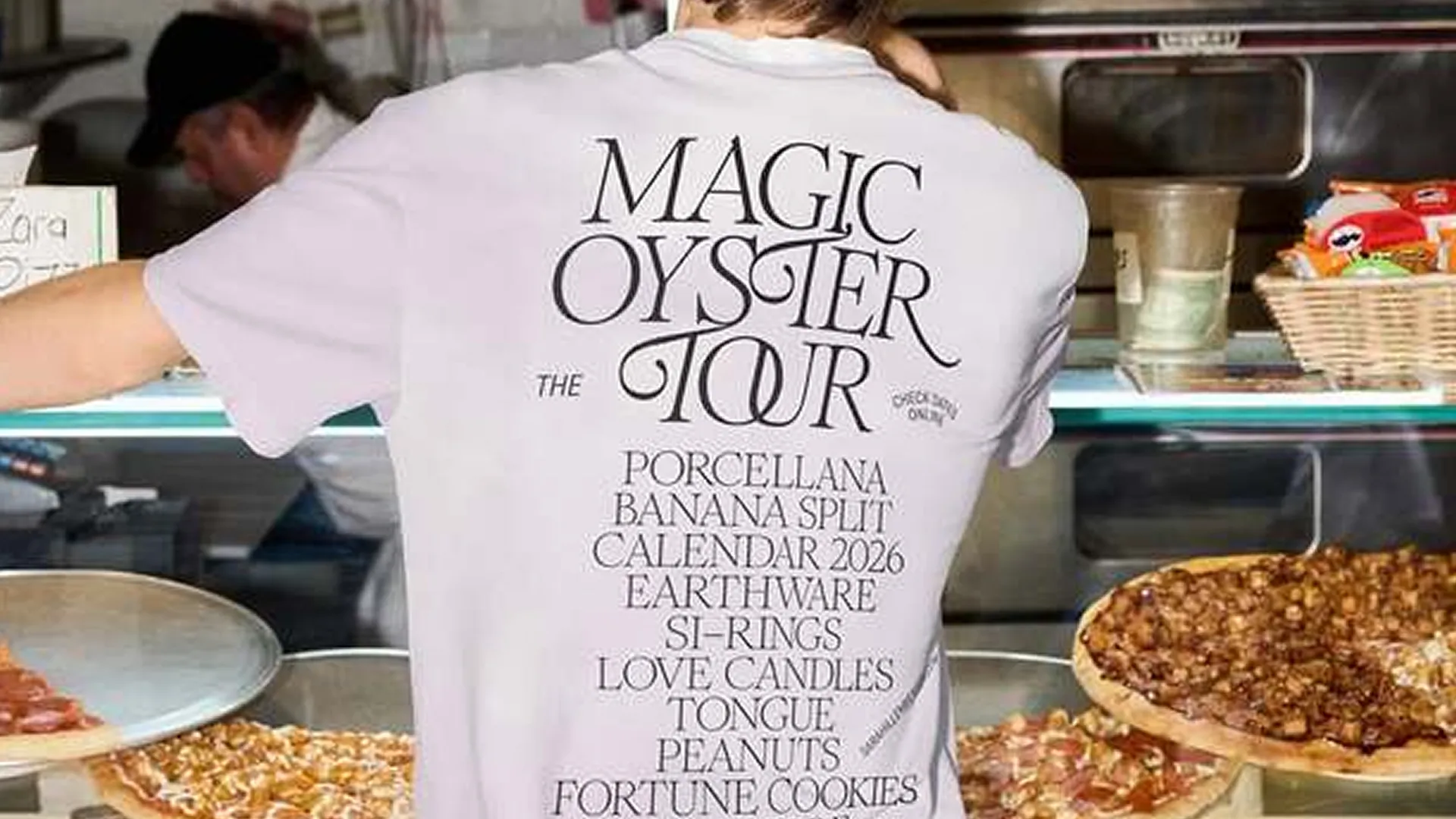
Herburg Weiland set The Magic Oyster Tour in Romie Italic, using two swash alternates and an OU ligature in the headline, and nothing else.
Herburg Weiland set The Magic Oyster Tour in Romie Italic, using two swash alternates and an OU ligature in the headline, and nothing else.

Romie, drawn by Margot Lévêque and published by Claude Type, her own type foundry. A 12-style calligraphic serif with swash alternates and a ligature set in the italic.

Afterall Research Centre, based at Central Saint Martins in London, and the organization's identity redesign by A2/SW/HK.

French type designer, founder of Claude Type. Best known for Romie, a calligraphic serif first released in 2019, now a 12-style family.

Henrik Kubel is a Danish type designer, living in London as of 2026. Co-founder of A2-TYPE Foundry.
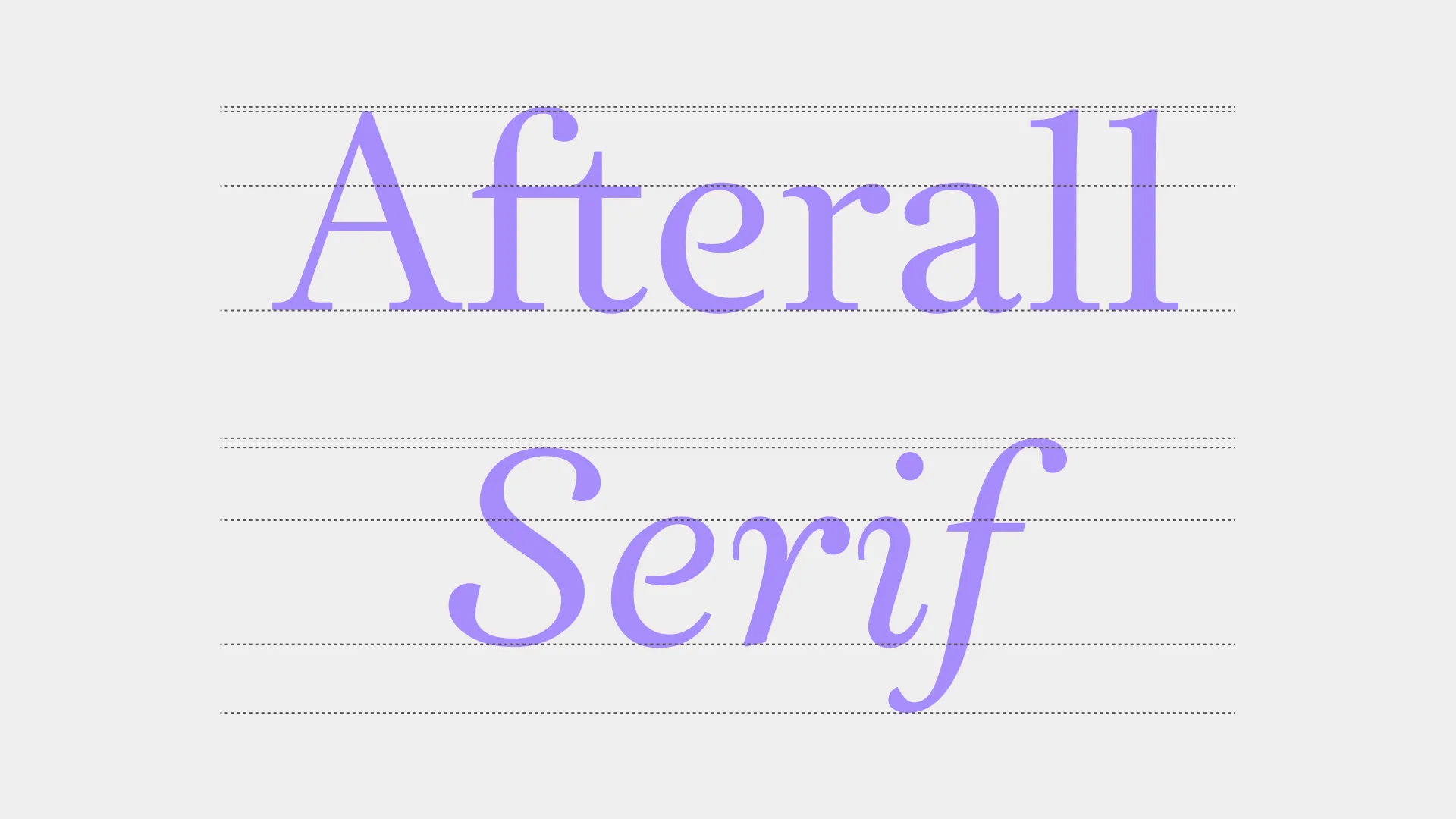
Afterall Serif, drawn by Henrik Kubel as part of A2/SW/HK's identity redesign for Afterall Research Centre. Published by A2-TYPE.
Type foundry run by Scott Williams and Henrik Kubel, based in London and founded in 2010 as a division of their design studio A2/SW/HK.
No results match your selection.
Toggle features on and off. Upload your own typeface. See how they work.
A Bézier curve is a parametric curve frequently used in computer graphics and related fields such as type design. Bézier curves are used to model smooth curves that can be scaled indefinitely.
The mathematical basis for Bézier curves is the Bernstein polynomial (1912), but its applicability to graphics was understood half a century later. Bézier curves were widely publicized in 1962 by the French engineer Pierre Bézier who used them to design automobile bodies at Renault.
The study of these curves was first developed in 1959 by mathematician Paul de Casteljau using de Casteljau's algorithm, a numerically stable method to evaluate Bézier curves, at Citroën, another French automaker.
| Fraction | Amount | Count |
|---|---|---|
| 89 12/3 | 293,987.00 29,387.00 | 780 |
| 45 34/78 | 456.09 | 7,389 |
| 81 90/31 | 1,234.31 | 23 |
| 81 92/87 | 3,231.31 | 928,378 9,283 |
TrueType fonts use Bézier splines composed of quadratic Bézier curves. Type 1 or PostScript fonts use cubic Bézier curves. Imaging systems like PostScript, Metafont, and SVG use Bézier splines composed of cubic Bézier curves for drawing curved shapes. OpenType fonts can use either kind, depending on the flavor of the font.
From Luc Devroye’s “Bézier curve” text.
A Bézier curve is a parametric curve frequently used in computer graphics and related fields such as type design. Bézier curves are used to model smooth curves that can be scaled indefinitely.
The mathematical basis for Bézier curves is the Bernstein polynomial (1912), but its applicability to graphics was understood half a century later. Bézier curves were widely publicized in 1962 by the French engineer Pierre Bézier who used them to design automobile bodies at Renault.
The study of these curves was first developed in 1959 by mathematician Paul de Casteljau using de Casteljau's algorithm, a numerically stable method to evaluate Bézier curves, at Citroën, another French automaker.
| Fraction | Amount | Count |
|---|---|---|
| 89 12/3 | 293,987.00 29,387.00 | 780 |
| 45 34/78 | 456.09 | 7,389 |
| 81 90/31 | 1,234.31 | 23 |
| 81 92/87 | 3,231.31 | 928,378 9,283 |
TrueType fonts use Bézier splines composed of quadratic Bézier curves. Type 1 or PostScript fonts use cubic Bézier curves. Imaging systems like PostScript, Metafont, and SVG use Bézier splines composed of cubic Bézier curves for drawing curved shapes. OpenType fonts can use either kind, depending on the flavor of the font.
From Luc Devroye’s “Bézier curve” text.
The OpenType Features Viewer uses Recursive typeface by ArrowType to showcase the capabilities of OpenType Features.